
At the Heart of Family Learning: Community Transformation Begins with Families
If you’ve followed our social media this month, then you’ve had the chance to learn about our recent family literacy work and to hear from some of the participants whose lives have been impacted by that work. As National Family Literacy Month® comes to a close, I wanted to take a moment to highlight one of the family literacy participant stories that were shared at the 2023 Families Learning Conference last month in Omaha. These stories are at the very heart of what we do at NCFL: working hand-in-hand with literacy practitioners and families across the country to make a positive impact for multiple generations of families and their communities.
Inna’s family literacy story began in early 2022. At the time, Inna was living in Kherson, Ukraine with her husband and three children. But as bombs began to fall on the city, Inna and her family chose to flee to Nebraska where her husband had family. “We left everything,” Inna said. “Our businesses, our house, our car. Our whole lives fit into four suitcases.”
A native Ukrainian speaker, Inna had taken English classes in school. But her English skills were not sufficient for her new circumstances. Not only did she suddenly find herself making a home in a country that wasn’t her own, her inability to communicate made an already monumental task feel that much harder. Inna was so eloquent when she described the loneliness and dependence she felt in those first days in Nebraska: “I think it is difficult for many people to imagine what a person feels when everyone around them speaks an unfamiliar language. That’s okay. I didn’t understand this before either. You seem to be there, but you seem to not be there. You can’t ask something in a store or pharmacy. You constantly need to ask someone to help with translation. And when suddenly you begin to catch some phrases and understand their meaning, it feels like a miracle. This is probably how a child feels when he starts walking.”

The ‘miracle’ of that first moment of understanding was made possible because Inna was invited to attend English classes as part of NCFL family literacy programming. With help from truly dedicated family literacy practitioners, Inna’s English was soon good enough that she was able to become more involved with her children’s education and successfully interview for a job at a hospital in Lincoln.
Inna’s success in family literacy is her family’s success. As a parent, her effective engagement in her children’s education will translate to better academic outcomes. As a provider, her ability to enter the workforce will translate to better economic outcomes. And it is these kinds of ripple effects, compounded across dozens of families, that begin to affect community transformation.
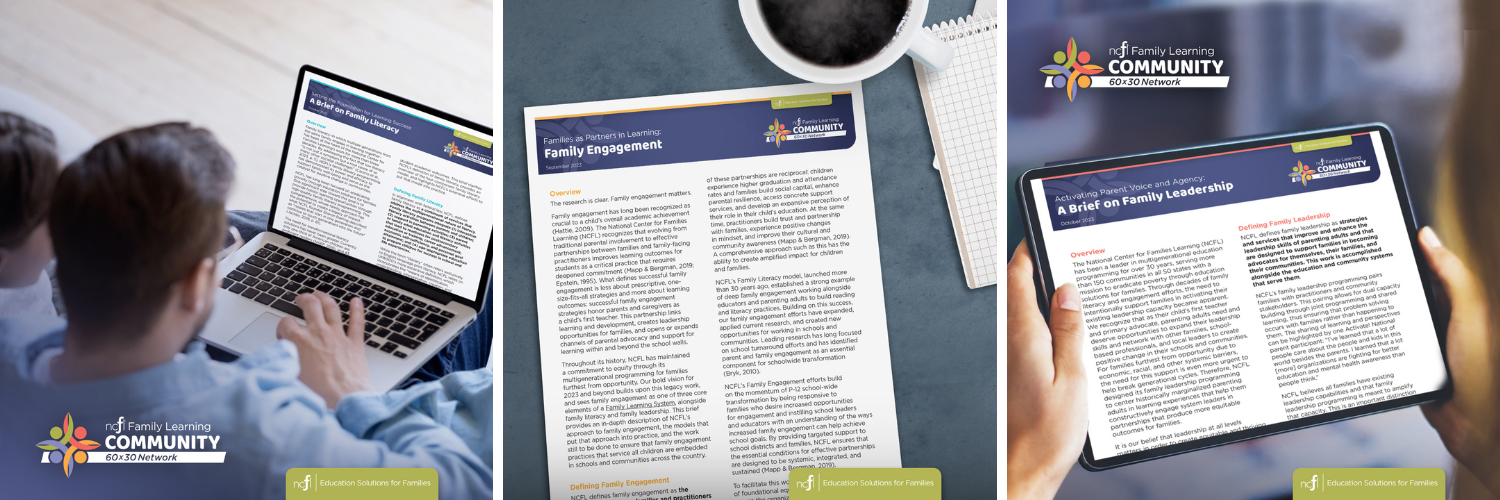
Last month, NCFL published three new briefs that detail our family literacy, family engagement, and family leadership models and describe the research that underpins these models and the ways we put them into practice. While these briefs provide crucial context for our programming efforts across the country, in many ways they only tell part of the story of NCFL’s impact. The rest of the story can be found in the family literacy journeys of Inna and the tens of thousands of other participants we’ve worked with over our 34-year history. Visit our YouTube page to explore more of these stories.
Are you an educator, practitioner, or family who has worked with NCFL in the past? We’d love to hear how family literacy, family engagement, or family leadership programming has impacted your personal or professional trajectory. Share it with us at info@familieslearning.org. Or visit familieslearning.org/60×30 to learn how you can create this change in your community.
ABOUT THE AUTHOR
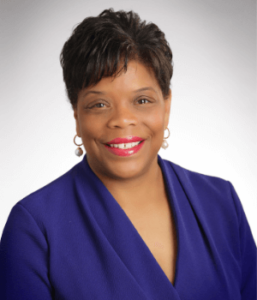 A lifelong educator and national thought leader for teaching and learning, Dr. Felicia C. Smith brings decades of valuable experience to advance NCFL’s mission of working to eradicate poverty through education solutions for families. Having served in a variety of leadership roles in P-12, higher education, nonprofit, and philanthropy, her career has allowed her to experience leading systems and develop a unique vantage point of a learner’s educational trajectory from preschool to adulthood. Smith holds an Ed.D. in education leadership and administration from the University of Kentucky, and an M.A. in elementary education with an emphasis on K-12 literacy development and B.S. in elementary education from the University of Louisville.